
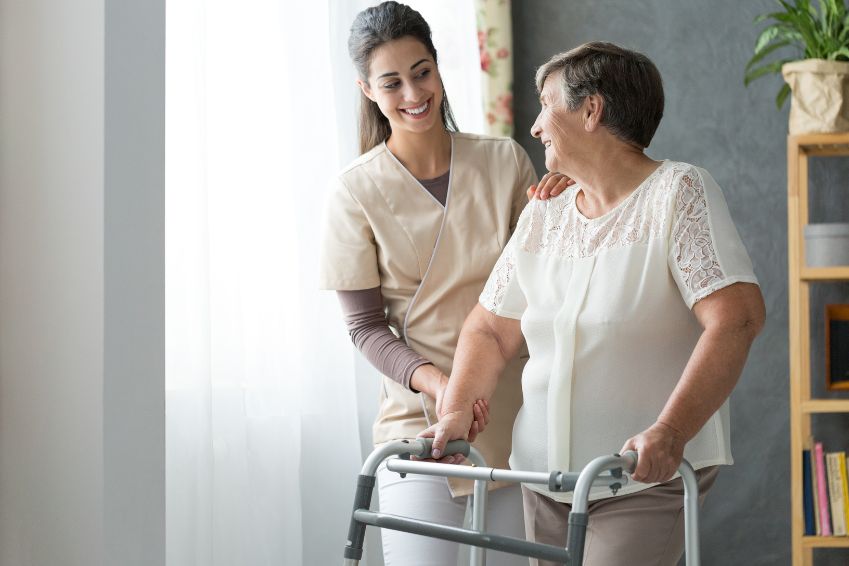

When a person comes home from the hospital after surgery or a serious health event, the care doesn’t end. It moves in. Home becomes the setting for recovery, and everything that goes on there, including when someone takes medication, how a wound is tended, if a person gets help moving around, and how well someone rests, helps determine whether a person will heal or will return to an emergency room. The aide who walks through that front door bears more weight than most families know.
Custodial Care vs. Skilled Observation
There is a difference between having someone come in just to help with the basics (cooking, cleaning, and running errands), and having an aide that is actually monitoring recovery. The former is basic care. The latter depends on a clinically trained aide.
A clinically trained aide has been taught to understand what a normal temperature is and what is a fever. They know what a normal blood pressure reading looks like for a patient with hypertension. They know what’s an acceptable heart rate and what might be suspect. What the post-surgical recovery of a hip should look like compared to a knee. What subtle changes in skin color, breathing pattern, or gait might actually signal. This isn’t diagnostic work, it’s pattern recognition built by structured clinical education, and it’s one of the most undervalued functions in home-based care.
This is what elevates the aide from companion to observer. Doctors and remote nursing staff can only act on what gets reported. The aide is who does the reporting. Their ability to recognize a “red flag” before it escalates is what keeps that 30-day readmission from happening.
Why Training Directly Reduces Readmission Rates
Recovering at home after surgery is risky. Wound infections, blood clots, falls, missed meds, these aren’t rare. They are common and avoidable with appropriate training followed to a T. For instance, while you can train a family member or friend to assist with a post-op patient, you can’t train them to know what a certified home health aide knows.
Infection control is one of the most obvious examples. What looks like a clean, innocuous wound one day to an untrained eye can fester on another. An aide will be able to spot the difference and communicate subtle changes to the clinical team prior to sepsis. You can’t teach that with a good heart.
Falls are another. Home health aide fall training does not include “pick up that throw rug dear”. The training will include medication and condition-specific mobility and balance factors, proper transfer setup, and when to utilize transfer lift equipment. Again, not something you just err on the side of caution with and lift/pull on your loved one.
According to the Journal of the American Geriatrics Society patients over the age of 65 are less likely to be readmitted within 30 days if they had post-discharge professional home health care. They were trained and supervised till they really knew their stuff, not just caring and hoping for the best.
Behavioral Care and Cognitive Decline
People recovering from hospital stays need different types of aftercare depending on what they are recovering from. Also, facilities focusing on treatment for one condition might not be adequately prepared to deal with the other health issues their patients present. For example, people with dementia are prone to agitation in unfamiliar settings. Unmedicated patients with major depression often don’t have the attention span or focus to benefit from physical therapy.
This is why for people with both a medical and a psychiatric condition, comprehensive home care is often more effective than institutional care. It draws on a higher level and wider mix of expertise in designing a plan built around the person. And it’s often far more cost-efficient.
For example, the same trained aide who directly assists the patient with recovery in the morning can make sure the patient connects with friends or family for a social component to help continued recovery in the afternoon. Then, those friends and family will know who to contact if treatment triggers behavioral issues.
What Credentials Actually Represent
Standards required to become a certified home health aide exist because the work is clinical. ADL assistance, vital signs monitoring, infection control, nutritional support for medically specific diets, safe equipment operation, documentation standards: all that is built to protect a patient who is still vulnerable. That’s the training and the role.
The difference between what a credentialed aide does and general personal care will always be vast, for that reason. A credentialed aide functions as a cohesive part of a care team rather than serving as an isolated support figure, and that distinction has to remain as clear as ever.
When a doctor sends a patient home, they are making a clinical decision: namely, that recovery can safely continue elsewhere. Specialized home care is the engine that ensures that clinical decision works out.
Chronic Conditions Require Ongoing Management, Not One-Time Help
For older patients with COPD, diabetes, or heart failure managing a recovery episode, the living environment is not “post-acute.” It’s active. Those conditions are under constant watch, oxygen levels, fluid retention, blood glucose trends, and that happens only as consistently as the caregiver has been trained to recognize what they’re observing.
Nutritional support dovetails here as well. “Diabetic” and “low sodium” are not menus you want confused in the kitchen, and improperly preparing food for a complex patient will lead to setbacks that may seem ever-so-slight in the recovery process but begin to add up all the same.
Home recovery succeeds as long as the caregivers are prepared for what the home actually demands. The hospital stay is measured in days. The recovery is measured in weeks. That’s where training brings the value.
